On the first of January, 1964 Bantam paperbacks published Simulacron-3 by Daniel F. Galouye. I was 13 going on 14 then. Sometime later, I don't know exactly, but it was certainly before 1966 I picked up a used copy of the paperback exactly as shown on the Wikipedia entry. It's one of a few books I read in my formative years that I remember vividly. The story was about marketing research being done by powerful AI computers. These computers create a simulated world of people to receive product marketing messages being tested. The extent to which marketing based on scientific (mainly psychological) research manifested itself in the 50's in the US was the subject of a book published in 1957 by Vance Packard called The Hidden Persuaders. Galouye, like Packard got his start in the newspaper business. I also read the Hidden Persuaders, but probably after I had read Simulacron-3.
The extent to which this book remained in my memory was largely unknown to me until the release in 1999 of The Thirteenth Floor, a movie by Josef Rusnak produced by the Emmerichs and executive produced by Michael Ballhaus. Ballhaus was Rainer Werner Fassbinder's cinematographer for 16 films in the 70's and in 1973 they made an adaption of Simulacron-3 for German Television called Welt Am Draht (World on a Wire). I think this was the only science fiction that Fassbinder made. I tried for many years after I learned of the Ballhaus link between The Thirteenth Floor and Welt am Draht in 1999 to see it. Several years ago I finally watched it from a PAL DVD on a cheap chinese DVD player that could transcode in real time to NTSC. Now, you don't have to go to such lengths as a Ballhaus supervised digital transfer is available on the Criterion Collection. If you have Hulu+ you can even stream that version. I intend to do that soon.
The topic of virtual reality seems closely related to the nature of reality in the first place. Psychological exploration of reality is a meme in science fiction and the imagery used, especially in television science fiction is fascinating. The use of mirror's is one such technique. Another motif is the presence in the frame of video monitor's, which can serve to show another version of reality, make references to other times and places or impute the presence of a 'watcher'.
Fassbinder's use of mirrors and monitors is discussed by Ed Halter in World on a Wire: The Hall of Mirrors . My first recollection of the use a monitor in a scifi movie came from Fritz Lang's Metropolis and Charlie Chaplin's Modern Times. I also want to mention, as Halter does that using monitor's these day's is a low budget option (not sure about the 30's) and was used quite effectively in television's Space 1999 series.
Wednesday, December 17, 2014


Wednesday, February 12, 2014
Retirement update, 1.5 years in.
I am in a good place, with Kathie, in Georgia near her extended family. We have a fairly rich life with family, new friends and the classes we have taken with the Brenau University Learning and Leisure Institute and the trips with it's hiking club every month.
I had an amazing backlog of books to read and several tech projects before retirement but I have not found the time yet for them. I think my book backlog is actually bigger now.
I had an amazing backlog of books to read and several tech projects before retirement but I have not found the time yet for them. I think my book backlog is actually bigger now.
Vacations still seem like vacations and are just as infrequent as when we worked. When I am at home, I don't feel like I am on vacation even though I am not working.
We are still trying to maintain the budget we created at retirement, it's not happened yet, but I don't feel stressed by money. Through out the day I have occasions when I feel like I am supposed to get back to work, but then I can't figure out what that might be. I don't follow IT technology as much as I used to and things are advancing away from me there. I am still keeping up with digital photography, technically at least, and am trying to bring some art into my work.
I have done some PC work for my Brother-in-Law, Joe, so I still know some computer troubleshooting and repair. I built a faster PC with a motherboard/processor swap and added a GPU to the mix. (Yes, I do have several photo software packages that can use the GPU) I have set up a home server and debugged it and just to prove that you can't be paranoid enough I purchased a CrashPlan family license and set that up. I discovered the author's of CrashPlan, code42 when I worked for the Medical School. We set up an in house system behind the firewall of the Health Systems network to offer workstation backup (PC, Mac and Linux) to our faculty and staff. Our sysadmins liked it too and used it as a second backup for some of our Linux servers. CrashPlan does do encryption before it sends data out so really no HIPPA worries there.
The personal client is quite nice, it has a scheduler and the ability to do multiple backups either to any attached drive or anyone else's computer running the client via a security token that you share, this is on top of code42's cloud servers. For no money then, as the client is free, one could set up a peer to peer backup system.
Well, that's the summary and I am sure I neglected to talk about something much more important than backup systems, but right now, I can't think of it.
Monday, January 20, 2014
Camera nostaglia
I have just come back from a walk with our dog. It's fairly cold and very quiet this morning and my mind starts composing commentary. Yesterday it was about the sensory impressions during the walk and that one, like most of them, never made it out of my head. Today, it was about my personal camera history. Not very interesting to most. However, it's at one end of the spectrum of being a camera geek and I don't mean that in a flattering way. There is a current dialog among the photographic blogs that I follow which is filled with angst over camera equipment and what it means to photography. This is really another formulation of the impact of technology on western civilization. I have long realized that I am fascinated with technology. It started at a fairly young age, in the final two years of grade school. Some signal events that remain with me, some 50 years later. Making a slide rule with log graph paper, scissors, cardboard and glue in Math class. Making a metal detector with my genius friend in his room, he designed the circuit, I used scotch tape to secure twisted wires around a transistor, resistors and capacitors. It worked!
Some eight years later I purchased my first camera, a Canon Tlb and 50MM lens. I believe I purchased it at Woodward camera in Michigan. I am not sure why, except to say it was a technology. My dad had always had a 35MM camera, he preferred to buy used Kodak Retina fixed lens cameras. I never used one until much later. I remember one of the first 'technical' age gaps. Believing that SLR's were 'real' cameras, and those Kodak fixed lens cameras not up to date, I bought my Dad a Rolleiflex SL35M. He tried to use it, it broke once and needed repair under warranty (these were made in Singapore and had poor quality) and he never did get the hang of match needle metering. He went back to the Kodak's where it was all manual and one just looked at the Sun conditions and set shutter and aperture, one combination for bright Sun, another for cloudy and you winged it in-between.
I must have learned something about being too geeky, as I bought a Canonet QL17 for my future wife. Man, I wish we still had that camera, but it got passed on to a dear friend.
I must have learned something about the downsides of the inevitable march of technology when I purchased an 'upgrade' for my trustly Tlb, a Canon AE-1. That didn't last long, I really could not adapt to the automation. I sold that one on and went back to the mainly manual Tlb. That lasted until the 2nd or 3rd generation of autofocus camera's came on the scene. By then, I had built a darkroom, with an Omega enlarger, Componon lens, trays with working plumbing and a digital light timer. It is notable, in my mind at least, that I built the digital timer myself. It was one of the first solid state circuits that I ever understood, a simple 555 timer and digital logic which I understood. Analog transistors had somehow eluded me, but digital seemed perfectly clear.
Still, I was convinced that following the Ansel Adams Zone system in my darkroom, an extensive series of test exposures and development variants carefully recorded in a notebook, to calibrate my camera to zones, would make me a better photographer. This is not so much different to this day, but magnified by the endless supply of digital source.. How many raw processors have I tried? I am embarrassed to say. How many test exposures have I taken? And, this despite knowing that after all my technical hard work with the Zone system, I still did not take better photo's. That was the lesson that I had ignored in Adam's writings, focused instead upon the mastery of technological artifacts and processes, I had missed the actual ability to 'see' a photograph before the shot!
Friday, January 10, 2014
Hey, a new post ! Camera hardware again
The weather has been gray and drizzly since the great Polar Vortex headed north of us. In other words, not much inclination to go out and take photo's. I am really happy with the family photo's I took over the Christmas holiday (Pre-Vortex), which you can find here: Christmas 2013 . Since then I have been staying indoors and scanning lot's of old family photo's ranging from the early to late twentieth century.
Just today, I read a post over at the SoundImagePlus blog that pretty much explained the reasons why David Taylor-Hughes no longer uses his micro 4/3 gear. My reason's for switching to the Fuji X-System are similar. The reason I switched to micro 4/3 from my Nikon D300, which I was very happy with both operationally and image quality wise, was the weight and size. Carrying the D300 plus lens kit around all day when on vacation was painful. By using the photographic pixel peeping section of the internet I was able to convince myself that four-thirds and then micro four-thirds had the image quality to complete with the D300. I was wrong about that as it turns out, but I had made the commitment and believed that sensor's would improve over time plus lens quality could be exceptional. By the time the OM-D E-M5 was released, I had sold off the Nikon D300 and lenses and then the panasonic G1 and G3 and Olympus E-PL1 to switch to it. It was to be the last camera I bought since I was retiring soon and would no longer have the income to afford this hardware obsessed hobby that digital cameras are. I was pretty happy with the E-M5 results and had acquired over the years some good lenses for it, in particular, the PanaLeica 25MM F1.4 and the Olympus 9-18MM zoom. My gamble on the constant improvement in camera + sensor coupled with the excellent lens selection seemed to pay off. Then I had my E-M5 and it's kit zoom along with a bag and accessories stolen. Just then the E-M1 was a near term future and I decided to wait a bit to replace the E-M5 as I had a cheap E-PM2 with the same sensor in it and still had my high quality lenses.
I then started reading about the Fuji X-System and it's high ISO abilities coupled with a superb line of (affordable) lenses. That got me to thinking about what micro four-thirds still hadn't accomplished compared to the now ancient D300. That was high ISO shooting. As it turns out, I quite like taking available light photo's both for family occasions as well as travel. I am not a strobist. Even with F1.4 the E-M5 shot's at indoor museums and sights needed the ISO cranked up quite high. I had learned that going much beyond ISO 800 was going to yield too much noise for my tastes. That had led to lower shutter speeds and despite excellent image stabilization I had a lot of unusable shots. So that got me to thinking, how much size and weight would I have to sacrifice to move on to the Fuji X-System, and would it's high ISO actually work in practice as well as it did on the Internet pixel peeping comparisons. I did a physical comparison with the E-M5 with the PanaLeica 25MM F1.4 and the Panasonic 14MM F2.5 that I owned. For the Fuji, I used the XE-1 along with the 35MM F1.4 and 18MM F2 as these are basically equivalent (except for depth of field).
| Width | Height | Depth with Lens | Weight with Lens | |
|---|---|---|---|---|
| E-M5 + 25mm | 4.8 | 3.5 | 3.9 | 21.1 |
| X-E1 + 35mm | 5.1 | 2.9 | 3.5 | 18.9 |
| E-M5 + 14MM | 4.8 | 3.5 | 2.5 | 16.1 |
| X-E1 + 18MM | 5.1 | 2.9 | 2.8 | 16.4 |
| E-M5 + 75-300 | 4.8 | 3.5 | 6.3 | 29.1 |
| X-E1 + 50-230 | 5.1 | 2.9 | 5.9 | 25.5 |
Suprised? So was I. The situation at the very long end and the very wide end was still going to favor micro four thirds but in the middle where 80% of my shots are taken, well, no sacrifice at all! Being cautious I came up with the idea of buying a Fuji X-M1 plus kit lens that I found at a great price. It would be my high ISO camera if the image quality was good. Not only was the image quality good, it was the equal or better to the E-M5 (at least for my uses) and the high ISO while not quite as noise free as Internet would have you believe, was very good up to ISO 3200 and 6400 in a pinch. Then the X-E2 was released. I pre-ordered it and proceeded to sell everything I could on e-Bay including some legacy Zeiss full frame len's that I was hoping to use on adapters eventually. The X-E2 handling was good enough to compete with the OM-D series and I saw no point in continuing on with micro four-thirds.
Another point that David made was the micro four-thirds gear lost it's value rapidly. That's true for the camera bodies and the kit lens, but not true for the high quality lens line up. I lost a little money on lens sales but between micro four-thirds and Zeiss Contax I was able to buy the X-E2 and the 14MM F2.8 wide angle along with the 18MM F2 to augment the kit zoom. I did not buy any of this new, I got them at demo and used prices, about 80% of new.
It was true that the going price for my E-PM2 and the 14MM F2.5 was so low that it was not worth the effort to put them on e-bay. The E-PM2 and 14MM are actually pocketable, though I find myself using the Fuji's anyway. The X-M1 is almost the same size and 2 Oz heavier than the E-PM2......and there is a nice 27MM Fuji pancake out there that is slightly larger and heavier than the 14MM F2.5 panasonic! Now, what else can I sell on e-bay :)
Tuesday, December 24, 2013
Why I don't post more often, perhaps diffraction effects are working in my brain :)
Last Thursday I decided I would do some photographic tests to see just what Fuji's LMO or Lens Modulation Optimizer does compared to not using it. I did some shots of the trunk of a paper bark tree around the neighborhood. This was probably not the best choice of test subject, since only a narrow band would be in the area of focus. I have plenty of brick wall's to shot but the proverbial joke about folks taking pictures of brick wall's instead of 'real' photographs is in my mind whenever I see one and am tempted to take some 'demo' shots.
So, I found the area of focus and created a table of 500 x 500 pixel extracts from each aperture with LMO turned on. To create the non-LMO comparison I decided I would use a raw converter since LMO is only applied to Fuji's in camera raw to jpeg engine. Of course the obvious solution, which I realized only last night, was to use the Fuji's in camera raw engine to develop the exact same way but with LMO off. That would be the KISS way to do it. And no, I do not mean the rock band KISS. So perhaps it was for the best that I got caught up in a protracted search for more information. Here's what happened and why this comparison is still unpublished.
First distraction was using the raw converter, I have Photo Ninja and that was my first choice. The color's are not the same as Fuji's jpegs and I can't really get them the same in post processing as I am a little color challenged. While I was doing the post processing I realized that I also have a deconvolution sharpening plugin from Focus Magic and I could use that and compare it to the Fuji LMO results. It has been claimed, but not by Fuji, that I can find, the LMO is a deconvolution operation. Fuji does claim that it works selectively between the edge's to the center of the image. Straight deconvolution, like used by Focus Magic, would effect the entire image equally.
So off I went to do some research and see if I could find more sophisticated deconvolution software to compare against the Fuji. It was then that I found some old code created by John Costella over a 2 year period and released in 2001. http://johncostella.com/unblur/ I then got distracted from there because he had developed this code to process the infamous Zapruder film of the JFK assassination. The results of this sharpening and reconstruction of the film frame by frame was claimed to prove that the film was significantly altered if not faked in it's entirety. It's not my intention to weigh in on that argument, but I did find it interesting and it in turn lead me back into the seemingly endless material on the assassination. I spent a few hours on that before I realized I dropping down the rabbit hole again.
Then preparations for Christmas began and I needed to take some holiday photo's and do other things.
So that's how that happens with me, I start out to do one thing, then a small amount of second guessing sends me to the internet to make sure I am not making a fool of myself, which seems nearly impossible to prove on the internet :) I feel like I am an internet James Burke with a new series of 'Connections' episodes. Before I know it, day's if not weeks have passed, I have pursued and dropped several other lines of research and have lost my zeal for posting anything at all. Then I have a break through as described above and am now thinking of going out with my tripod and using a brick wall.....
But wait a minute, have I actually examined the evidence I do have in hand? Not closely it turns out, so I spend some time with that and it looks like I can see differences in detail both between lmo on and off and between lmo and focus magic. Better yet, the differences are greater at higher apertures where diffraction blurring is most pronounced.
Wednesday, December 11, 2013
Generational change in photography
Two recent blog posts by photographic bloggers that I follow, Kirk Tuck here: http://visualsciencelab.blogspot.it/2013/10/the-graying-of-traditional-photography.html and David Taylor-Hughes here: http://soundimageplus.blogspot.co.uk/2013/12/unapologetically-old-school-continuing.html discuss the notion that generational change is changing photography (or at least the photography market).
I don't agree about the generation gap but then it's not black and white, 100% one cause or the other.
This discourse is much more complicated than any one of us will be able to explicate. It's complicated because several orthogonal issues are involved. One of those is our attitudes towards technology which is coupled with our attitudes towards change. Another issue is the nature of market driven change in technology dominated industries, of which photography is firmly planted. Finally there is the issue of ageism or age discrimination, is it the same as saying the old guard doesn't "get it"? I have a 30+ years of professional experience in IT and 30+ years of amateur experience in photography, which means I am a member of the cohort who is clinging on to the past in the face of tumultuous change.
Change and lack of it. A contradiction. Change is the one constant in IT, yet old stuff that works hangs around seemingly forever. The change comes with newly installed systems. I once did a survey of web servers on our intra-network and discovered that the release level of the software was much pretty much stuck at the level it was when installed, no matter how long the server had been running. Some people are reluctant to change expertise while others are eager to move on to something new. In my experience, neither one is associated with age except that it's widely assumed that the older you are the less you know about new stuff. That assumption is ageism. I think a lot of it has do with the individual, did you have to struggle to acquire expertise or understanding? If so, you are more likely to resist change. Do you like to be challenged or prefer a relaxed stability? This leads us to another issue:
Do you revel in the means and methods of photography? This is not orthogonal to having what I will call the artistic eye, but you can do one without the other, or both. Back in the film/chemistry days both Edward Weston and Ansel Adams did darkroom work with chemicals. But there was a vast gap between the 'geekiness' between the two. Adams was a technical nerd while Weston was not. Both had great artistic vision.
I spent of lot time 'calibrating' my photography workflow from exposure to printing, based on Adam's writings, it was very technical and right up my alley, but it did little to nothing to make me a better photographer. Then, as today, my best shots are opportunistic that just happen to work out. My planning for shots is rather sterile, technically good (or not :) but not artistic.
The old farts are missing the market, they don't get it. Established technology companies can loose their way not because they are run by a bunch of 50 yr old + executives. It's far too easy to say that the 50 year old cohort is stuck in the past. What they are really stuck in is capitalism. To be a successful large company means you meet your sales figures every quarter and to do that you ask your existing clients what they want from you. And they pretty much tell you that they want more of the same, incrementally improved and made cheaper. That great disruptive invention in the lab your team came up with, well, the sales projections show that it will not make a measurable impact on your sales goals, you have to let it slide for now. Maybe next year your clients will ask for it. The problem is, that by the time your clients ask for it, it's being provided by a start-up company whose sales are great for their size but inconsequential for yours until they start selling into your client base.
Not all large companies and senior executives behave this way, Steve Job's started his turn-around of Apple when he was 42 and kept it up until he was 55. Notably, what makes Applelarge today is not what the company did for most of it's life, i.e. make PC's.
To all the claims that photography workflow will be dominated by ease of transfer to social media, all I can say is that cell phones do the entire workflow quite well, or good enough for the majority, right now. That disruptive train has left the station and won't be coming back in until the next disruption. So where does that leave Nikon, Canon and Sony, not to leave out Fujifilm, Pentax, Panasonic, Olympus, Sigma and Ricoh? I am not sure. I don't think providing ease of publishing to social media will turn things around, it won't hurt but it won't replace the cell phone camera. They all are iterating the past, some with more panache than others. Are any of them trying to disrupt the market? Still not clear. Is micro four-thirds or Nikon/Sony CX or Pentax Q disruptive? Doesn't seem that way, it could be argued that all those products are just incremental improvements or variations on the same configuration of technologies. Could Lytro be disruptive? Could be, time will tell, but I doubt it because of how photographs are used.
Here is what I think drives photography disruption: How are the photographs used?
Professionally via prints or electronic distribution, i.e. fine art, advertising, event recording.
Personally via prints or electronic distribution, i.e 4x6 mass market printing and the internet. (maybe photo frames?)
I think cell phones handle most of the personal use. For those situations where they don't I see all kinds of people form all kinds of ages using DSLR's and mirrorless. I see the existing cameras handling the professional needs as well. Those needs will have change in a substantial way to drive disruption.
Disruption in the existing use means simpler and cheaper, it's hard for me to imagine anything else coming along other that what we already have or have seen. But then that's the nature of the future, largely unknowable.
Disruption could also be in a new use for photography. I can't tell you what that might be, once again, it's large unknowable until it's revealed. Maybe someone has seen a small niche that can't be served by the existing technology and a new kind of product is serving that market?
Sunday, August 11, 2013
Old vs New
My intended followup to my last entry is postponed, pun intended. Looking at my history of photographs got me interested in checking out some 'legacy' lenses. This has been far more complicated than I thought. I did not want to use a static indoor test scene with resolution chart embedded because I wanted to see if this phenomena of 'rendering an image' would also impact results. Probably the most repeated tests, simply because I wanted the results to be different, were between a Zeiss Contax T* Distagon 28MM F2.8 made for the Contax SLR, and a Leica Panasonic Summilux 25mm F1.4 made for a micro four thirds camera. I used an Olympus E-PM2 since my EM-5 was stolen. This is an outdoor shoot, in late afternoon, bright sun from a tripod and with the PanaLeica set to F2.8. Here those shots are:


The first is from the PanaLeica and three things are apparent even at a small size, it's sharper, more detailed and better contrast. (These are OOC JPEG's with the same settings). These were manually focused and the focus point was the same in each one, a knot in the wood.
One could argue that the Zeiss should be stopped down as much as the Leica, but it won't change the results. The Zeiss get's better up to F5.6 but it's still not as good as the Leica at F2.8. One could also argue that since both these lens were made in Japan, they are not true Zeiss nor Leica, yet both companies allowed their names to be used singly and prominently branded Zeiss and Leica by Contax and Panasonic.
My explanation is two fold, but I will likely never test it out. First off, the Zeiss is made to cover twice as large an area, it could be used on a full frame camera so using it on the PM2 was never in it's design parameters, secondly the Leica is newer technology made for the camera it was used with. So I believe that it's off to eBay for the Zeiss. As much as the name and build lends some prestige the results surely do not.
If I am right in my explanations of the differences, we have an example of how engineering in the past cannot anticipate the needs of the future. But this is just one sample and it's possible that either this Zeiss lens or this Olympus camera are just not compatible with each other....I have another Zeiss Contax, the 50MM F1.7 and I can put that to the test, what I don't have is a comparable lens for the Olympus, just standard 40-150mm zoom... More later
Friday, July 12, 2013
What get stored is getting larger
My last entry tried to describe how historical data in the electronic age can get lost and degraded over time. I intimated that the advent of purely digital storage systems would counter that scenario due to several properties of digital storage.
- Digital storage is content format neutral.
- Copying from one generation to the next generation of storage systems is a one step process and the same user cost no matter how large the content.
- For the same or lower operational cost, the next generation has larger capacity.
- You (or someone) is willing to expend the on going operational cost.
I used to think that continuous and sometimes rapid improvement of technological would have to come to an end. I don't think that end will be in sight as long as we maintain a commercially viable economy. ( I might be able to explain that assumption in a future post). The real bug-a-boo is the assumption that someone is willing to expend the costs. Even with the costs declining it's still a cost and has to be measured against any other use or value that can be had from expending that cost on something else. Which is a convoluted way of saying that maybe I, or you, or someone will get bored or tired of keeping the content around. Or find something else to store of higher value in that space.
I believe that content format will also play a role in that lack of interest in continuing to maintain the content, this is really a degradation of value. And it plays out in decades and sheer quantity. If you come to believe that the content has little to no value, say for example, because the content was acquired in a way no longer considered viable, why would you expend any effort to maintain it?
I think that statement is true no matter what the content, whether it be digital medical records or digital photographs. The variability in format is part of the picture, but in a subtle way. Let's take digital photographs. In the beginning of my storage I used jpeg and slowly added raw when it became available. I still shoot jpeg for a variety of reasons. First the summary:
A flower sample from each, a same sized crop from what a print would look like viewed from the same distance. At the smaller size all the cameras are pretty good (minus the bad exposures in several of them). At the larger size, I have never printed this large, to my eye's things don't start looking good until 12 MP. Too bad I didn't have the foresight to photograph exactly the same thing with each camera over the last 12 years :)
Here is what I realize. With flower pictures or any scene that can be easily found again in the real world, the superiority of camera's 2 to 3 generations ahead is so great that I am unlikely to keep the earlier photo's if I have to make a choice. I am still copying them forward, simply because it has little to no cost, since between 2001 and 2013, my storage had increased into the Terabytes on the server side and 8 to 32 GB memory cards in the camera allow me to shoot 2 week vacations in both raw and jpeg.
One more thing, while one can argue that for my purposes of on screen viewing and at max 8 x 10 prints, 12MP is as good 16MP. I do not think the MP increase is over and there are several reasons for that. There are advantages in reducing noise and increasing apparent acuity but perhaps the most important is that it allows a true digital zoom. The example here is to compare the Canon XT image to the Olympus EM5 image, one could crop out a 8 MP or so image from the Olympus and achieve acceptable digital zoom. First quality digital zoom wont happen until we have 24 to 36 MP to play with. You can already see that advantage in the smallish Nokia Lumia phone cameras that use 48MP to reduce noise and allow digital zoom.
| Date | Camera | MegaPixels | JPEG sizes | Raw Sizes |
|---|---|---|---|---|
| June 15, 2001 | Casio QV3000 | 3 | 1 | N/A |
| June 12, 2004 | Panasonic FZ10 | 4 | 3-4 | N/A |
| March 26, 2005 | Canon Digital Rebel XT | 8 | 3-4 | 10 |
| Feb 6, 2008 | Olympus E510 | 10 | 7 | 9 |
| April 5, 2009 | Nikon D300 | 12 | 5-9 | 11-12 |
| April 22,2009 | Panasonic G1 | 12 | 3-5 | 14 |
| March 26, 2012 | Olympus E-M5 | 16 | 8-10 | 12-13 |
A flower sample from each, a same sized crop from what a print would look like viewed from the same distance. At the smaller size all the cameras are pretty good (minus the bad exposures in several of them). At the larger size, I have never printed this large, to my eye's things don't start looking good until 12 MP. Too bad I didn't have the foresight to photograph exactly the same thing with each camera over the last 12 years :)
|
Camera |
11 x 15 print |
4 x 7 print |
|---|---|---|
|
Casio QV3000 |
 |
 |
|
Panasonic FZ10
|
 |
 |
|
Canon Digital Rebel XT
|
 |
 |
|
Olympus E510
|
 |
 |
|
Nikon D300
|
 |
 |
|
Olympus EM5
|
 |
 |
|
|
|
|
Here is what I realize. With flower pictures or any scene that can be easily found again in the real world, the superiority of camera's 2 to 3 generations ahead is so great that I am unlikely to keep the earlier photo's if I have to make a choice. I am still copying them forward, simply because it has little to no cost, since between 2001 and 2013, my storage had increased into the Terabytes on the server side and 8 to 32 GB memory cards in the camera allow me to shoot 2 week vacations in both raw and jpeg.
One more thing, while one can argue that for my purposes of on screen viewing and at max 8 x 10 prints, 12MP is as good 16MP. I do not think the MP increase is over and there are several reasons for that. There are advantages in reducing noise and increasing apparent acuity but perhaps the most important is that it allows a true digital zoom. The example here is to compare the Canon XT image to the Olympus EM5 image, one could crop out a 8 MP or so image from the Olympus and achieve acceptable digital zoom. First quality digital zoom wont happen until we have 24 to 36 MP to play with. You can already see that advantage in the smallish Nokia Lumia phone cameras that use 48MP to reduce noise and allow digital zoom.
Tuesday, July 9, 2013
Yet another new start.
Yeah, I have heard that before. Blogging is something that happens inside my head more than on the keyboard. I blog when I am driving or walking the dog. When I sit down to type, my intentions change and drift off into irrelevance.
I retired from the University of Michigan Medical School last September and moved away from my hometown of some 40 years, Ann Arbor, Michigan. We moved to be nearer Kathie's family and that has been a blessing and good move. My love/hate relationship with technology continues into retirement, sometimes it seems as if I have not retired at all since I still build, run and fix computers. My perspective has changed.
I now take preserving my digital artifacts (mainly photo's) with a high degree of paranoia. I used to speculate and wonder how we, that is the IT departments of medical centers, were going to be able to keep over a 100 years of medical records. Think of it, computers are at most 65 years old and most digital originated medical records less than a decade. We have no precedent. The same thing is true for our personal digital lives, our photo's, documents, movies and music. In my relatively long career in computers, just a little over 40 years and my nearly 45 years with home entertainment electronics I have seen so many fundamental format changes take place that I loose track.
My conclusion has been that the only way forward is to continuously migrate digital records to new technology. It's important when doing this migration to not loose data and that includes resolution data as well. Let me recount my history of audio format's as a parable of what mostly likely is happening in the entire digital era.
Well, I open of course in the analog era. My first source of music was 33 1/3 rpm and 45 rpm plastic records. These were spirals of a continuous groove dug into the plastic and reproduced with diamond or ruby needles tracing the modulations of an audio signal in the plastic. This was in the sixties, by which time this technology, first deployed by Thomas Edison in 1877 was close to a hundred years old. Think of it, a hundred years of technological development had reached it's pinnacle of perfection. In an early replay of the format wars which came to characterize recording and playback systems, the records disc, initially inferior to the records cylinder, but cheaper to make and mass produce, had become standardized as the 78 rpm record by 1925.
There was no home recording technology until the reel to reel tape drive appeared, copyright and patent battles settled and Sony started mass producing them. I owned several of them, a Sony, a Tandberg and a Teac. At their best, they could reproduce the entire range of a 331/3 rpm vinyl record (LP's or Long Play). In a comprize of data integrity (as we would call it now) mainly a degradation in signal to noise and frequency response, I used slower and slower recording speeds since that extended the capacity of my tapes. (hey, does this sound familiar to anyone?) I started recording my LPs on first play to minimize the noise degradation that always seems to accompany the playback of LP's. Due to time and costs, only a small portion of my LP collection was ever transcribed, and of those none are with me today.
Into the 70's, portable access to music was coveted, We wanted to listen to our music in our car's and then everywhere we were. The first format I used for that was the 8 track tape cartridge. This was a continuous loop of tape ingeniously placed into a plastic box which was open on one end to expose the tape for reproduction purposes. Of course, this was a highly compromised format, but very popular for a while. IT fit easily into a car, but was still too big for true portability. Home recording was very limited and never really took off. Then came the cassette tape. This was a miniaturized reel to reel tape and very portable. Technological advances attempted to overcome the compromises of the format and home recording became easy and cheap. Hence the appearance of that new social phenomena, the mix tape. Yet another social (or anti-social as it were) development, the 'walkman' appeared. A tape player you could wear on your belt and listen to in private with headphones. I eventually abandoned reel to reel and started recording my LP's onto cassette (it was good enough) and making mix tapes. Only a small part of my small reel to reel collection was migrated onto cassette. My main music collection was still LP's and I could re-record them onto cassette.
Indeed, I started a massive project to transcribe all my LP's onto cassette. Then came the Compact Disc, the first mass produced digital recording formation. Within a decade the cassette was dead. I, along with everyone else, stopped buying LP's and started buying CD's. I still transcribed them onto cassette, mostly out of habit. One day, I realized I was no longer using any of my cassette's, I had a portable CD player and a CD player in my car. Cassette tape was dead, CD's were audibly superior, but nor very recordable. Almost none of either my LP nor my cassette collection made the transition into CD's. The music that did re-appear, was because I purchased a CD copy.
CD's are a weird combination of analog waveform and digital recording. Reasonably lossless. But the next portable format was all digital and to make it small enough to be mass marketed, it involved compromising with data integrity. This was the MP3 format. Today, my home recorded CD's have MP3's on them, enabled with new technology since the basic CD format was digital in the first place, one could replace the analog waveform recording with a digital recording. There are loss less digital formats and indeed I once again embarked on a migration project, this time trans-coding all my CD's into loss less digital FLAC (free lossless audio codec) and storing them on a home media server. It's been years underway but I still have not had the time or inclination to migrate the entire CD collection.
So let's recap this long story:
LP's to reel to reel tape - less than 10% of the LP collection.
reel to reel to cassette - only a few titles made it because I had the 'original' LP's.
LP's to cassette's - maybe 33% were recorded and some were re-purchased.
cassette to CD - zero percent, a total replacement technology.
LP to CD - zero percent, no point to it.
CD (replaced LP's as the 'original' collection and now very much larger)
CD to MP3 - only a small amount of 'mix tapes' (ha, an old term continues).
CD to FLAC - so far less than 50% has made it. Once again, time and effort come into play.
So, the history of this analog to digital transcoding is not very impressive as far as any statistic is concerned, Data is lost (LP's and CD's not transcribed) and Data integrity is lost (LP to analog tape and LP/CD to MP3).
That brings us to the server story and pretty much back to my current interest in digital storage technology.
My first server was basically just my home PC. My next server was an old home PC turned into a Linux server. Following that was a dedicated Linux server. And after my most recent move, I purchased a small, low powered, linux based media server from Iomega (then bought by EMC and now bought by Lenovo).
So, I have already had 3 server technology transitions. But because each one of those was simply a way to record a digital format, there was no loss (of the source format) and the entire collections were able to be transferred. The reason the entire collections were transferred is that it took one operation for the entire collection. Basically, Copy *.* and go to bed..... Digital offers a great advantage over analog in that entire digital formats can be preserved easily, as to whether they will be understandable in 100 years, that's another story. Photography is perhaps a better way to tell that story however.
What is my history with photography like? Strangley enough, it's very similar to audio. Analog formats ruled the day for about a 100 years and copy and preserving was an act of reproduction using the newer cameras and films. Then came digital. My digital collection is now close to 13 years old. The only universal storage format is another compromise with data integrity, the jpeg format (very similar to the MP3 format in result). The lossless formats exist, but each camera manufacturer uses their own. Since we have owned five different brands, I now have five different lossless formats; CR2 (Canon), NEF (Nikon), ORF (Olympus), ARW (Sony) and RW2(Panasonic). Each one of them has made the server transition intact. The question is whether knowledge of those formats will last for the next 100 years?
Yes, there is a universal, lossless digital image format from Adobe called DNG. But I don't use that yet and along with the software ability to understand digital formats, that's another blog entry,.
Thursday, May 17, 2012
A suprise Netflix find
L
Cthulhu Watched the "Call of Cthulhu", a sort (46 minutes) movie on Netflix. I sort of expected a low budget horror film similar to all the other Lovecraft inspired movies I have seen, but this was quite different.
II
As you can see this was produced by the HPLovecraft Historical Society. I highly recommend following the link to get to their site. This will tell you all about the movie itself. This blog is about my experience of the movie, it is not a review.
If you are a Lovercraft fan or got to this site by searching for Cthulhu you might be disappointed because you already know about this movie, the story it's based on and the HPLHS. I can not add anything more to that mileau.
Yes, this is a 46 minute black and white silent movie made in the 21st Century. From the opening titles you know that the film makers are 'riffing' the past. Within the first 10 minutes there are 4 jumps in time and place, consistently moving backwards from the thirties ( I guess) to 1870. Maybe some historical silent movie has done this but I immediately thought we were in Inception territory. Surrealistic sets at place in 20's German film are here but without the budget of Murnau let alone Lang. Miniatures and movie monster technology out of 1925's "The Lost World" contribute to the period re-creation style.
Being a sort of movie buff I found all this enjoyable. After the film ended I researched at the web site and found a list of old movies which influenced this one. I had watched nearly all of the movies in the list. I am most curious to know the reaction of someone with no experience of these silent masterpieces to a modern day version.
Not all is rosy (or sepia), the fight scenes would have embarrassed Fairbanks. Faces are not as expression rich as in the best silents and sometimes the pervasive moodiness needs relief that does not come. But this is all in character with how I remember Lovecraft stories and this is intended to be a faithful translation to the silent screen of the short story with the same title.
Still, as an inveterate lover of 50's 'B' movie Sci-fi and Horror one comes to appreciate low budget creativity and this movie punches well beyond its budget.
Friday, April 27, 2012
Tuesday, July 5, 2011
bottom up community change
I read that a small village in Wales, Llangattock, had won a prize from British Gas to improve their energy efficiency. The whole story is a little more complex, it involved seed funding, community organization and a contest. It is a good example of how small community led, but large organization incented, change can create positive change. Here is a report about that uses Llangattock as an example of community led change in the wake of what these authors believe - "it is clear that both centralised state activity and unfettered markets are flawed when it come to achieving deeply embedded social change". Full report here:
http://tinyurl.com/3exoqvf
The key phrase here is "flawed", i.e. central activity and markets are not totally dismissed, but they are not sufficient nor perhaps even structured appropriately.
The story of the Green Valleys project in Llangattock demonstrates that a diversity of efforts, ranging from high tech - solar PV and micro-hydro to low tech revivals such as traditional woodlands managment can achieve remarkable results. Here is their web site for you to explore:
http://www.llangattockgreenvalleys.org/
I was also intrigued by mention of a 'small machinery ring' as a future activity. I did a google search and found this description of the Lothian Machinery ring. Their purpose is to share expensive farm machinery since such machinery forms a large and fixed capital cost in farming.
Friday, June 17, 2011
What I really wanted to talk about today
So, I do get it, that there are arguments that can be made about how climate change is either not happening or it's just part of the passing parade of weather, don't worry about it.
Let me give an example, the conditions or processes that can change climate are called 'forcings' and forcing can have feedback which either amplifies or attenuates the impact of the forcing. Turns out there are a lot of forcings and a lot of feedbacks.. In the recent report from the Artic council about the state of the Artic cryosphere, we find this - "Of those feedbacks expected to have strong effects, eight lead to further and/or accelerated warming, and just one leads to cooling."
Now, I could go to two different web sites and find one which used as it's 'evidence' that world is in imminent danger one or more of the positive feedbacks and another one which used the negative feedbacks as evidence that everything will be ok.
It's nice having these plausible physical explanations which can be incorporated into predictive models, but more important to me are these two facts, also embedded within the same report:
1) The intensity of feedbacks between
the cryosphere and climate are not yet
well quantified, either within the Arctic
or globally. This lends considerable
uncertainty to predictions of how much
and how fast the cryosphere and the
Arctic environment will change.
2) Model projections reported by
the Intergovernmental Panel
on Climate Change (IPCC) in
2007 underestimated the rates of
change now observed in sea ice.
Ok, so there is uncertainty and the models are wrong, but what's the trend? Things are happening faster and we don't know how fast they will go or if they will slow down.
Seems like that is a pretty big question and we better find out soon. Prudent risk management behavior would be taking mitigation steps for what we do know is happening with a plan to either ramp mitigation up or close it down depending on the outcome of more research and observations.
Follow up on the IPCC blogo-mania
I re-read my post from yesterday (that means at least one person has read my entries :) and realize that it could give the wrong impression. What I meant to say is that the content of the blogosphere reactions is political not scientific, although it claims to be about science...
The level of cross-linking and commentary triggered by Mark Lynas's single post creates a hyper-storm of content. This massive increase in information contains absolutely no increase in knowledge. From this kind of behavior, it's easy to see that after enough of these hyper-storms, finding knowledge in the sea of information get's harder. Already google searches return so much information that one has to be selective in what one chooses to follow-up on, and if you are trying to discern what is actually happening, then good luck.
Let me give a good example. Yesterday I found a youtube video of what looks to be steam release from fukushima reactor 4 that took place on June 14th. Some people called it an explosion, but I can't tell from that video what is happening. Searching the web for an explanation is nearly hopeless, the majority of links are dire warnings for which this 'explosion' is yet more proof for the point of view of the author with a link back to the youtube video.
It's easy to say that no one bothers to check facts anymore, but when it's this difficult, it's hard to see any other outcome but increased paranoia among the people who routinely plug into this stream of self-referential links. It's also easy to see how one can get the impression that the evidence for whatever you are talking about, in this case the 'explosion', is overwhelming, why I found 25 links talking about it!
Wednesday, June 15, 2011
IPCC shoot's itself in foot again.
Will the IPCC loose credibility with this event described by Mark Lynas: http://www.marklynas.org/2011/06/new-ipcc-error-renewables-report-conclusion-was-dictated-by-greenpeace/ ?
I suspect so, at least among non-scientists.
You can feel the frustration in Mark Lynas's response. You see, science needs to be 100% perfect in it's communications and on the Internet. It can't make mistakes or have people associated with it that have other, non-scientific, purposes.
The majority of critics get to play by different rules than science. James Hansen has noted that policy discussions and most public discussions take place using rules of Law. Climate Change is treated as the prosecutions case and all that is needed is to create reasonable doubt in at least one of twelve juror's. In other words, critics behave as lawyers and look for flaws.
Scientists look for flaws too and often discuss all possibilities. That is why the legal approach to science criticism is so effective, your 'opponent' provides more than enough 'evidence' to create doubt and spread the impression of confusion and malfeasance in the scientists.
Mark is right about the IPCC 'blowing' this. From a scientific perspective throwing out the possibility that renewable energy can reach 80% is ok, especially if it sparks examination about that goal. But that is not what is happening, because this was not science, it was a press release. Different rules are at play here. Climate Change, for the public, is a propaganda war now, not a scientific exercise.
Tuesday, April 19, 2011
Wow - Donald Trump
So, I have not posted in months, but I saw George Stephanopoulos's interview this morning. Apparently Mr. Trump thinks that we can threaten the worlds suppliers of oil to lower their price and/or increase their production ( to lower the price) by withdrawing US military protection. I think that whether or not we can afford to provide a military presence around the world, let alone in the Persian Gulf, is a good thing to discuss. But the consequences for world oil supply are not going to be that simple.
Sure, I think that if the US chooses to act as a financial trader and ruthlessly manipulate the oil markets even to the extent of invoking our military, prices could go down, but only for a while......they could also go up, way up! But just a spike way up. That's because I think there is some evidence that the world economy and oil prices are in a balancing act. We have reached the point where serious price escalation reduces demand, high prices create a recession and that keeps demand tamped down which creates oil surplus which lowers the price and given other macro economic conditions we can start pulling out of the recession, increase demand and start the whole thing over again....
You can read about this at Robert Rapier's consumer energy blog and also find pointers to other economic analysis. Robert call's this phenomena the "long recession'.
And yet another problem we face is that any surplus that is created by OECD demand destruction is consumed by the rest of world, leaving little surplus for us to build future growth on. Here is a sobering analysis by Jeffrey J. Brown over at the The Oil Drum (handle: westexas): In 2005, the top 33 oil exporting countries in the world produced 62.2 mbpd (million barrels per day) and exported 46 mbpd, that means they consumed, internally in their country about 26% of production. China and India imported 11% of what was exported. In 2009, those same countries produced 60.3 mbpd, consumed 17.5 mppd (about 27.5%), exported 42.8 mbpd and China and India imported 17% of that!
Note two things there, the producing countries are slowly consuming more of their production and the great growth rates in China and India are consuming a ever higher fraction of world oil exports.
So how can this be? How can 2 countries which are considerably poorer per capita than the US be able to afford the oil that we can't afford!
First, is it really true that we in the US are consuming less crude oil? In 2009, US oil consumption was lower than it was in 1998. The downtown in growth started in 2005 for the US and really picked up steam in 2008. From the dot.gov site we can look at monthly and annual miles driven in the US (a proxy for overall oil consumption):
 The peak was actually in February of 2008 and we have not recovered back to that level yet. Probably won't this year either. The point is that American's responded to higher oil prices by driving less thus consuming less.
Second, if oil and oil products like gasoline are so much more expensive for us that we change our consumption how can the Chinese and Indians consume more. I think the answer lies in how far one's energy goes. Another post on The OilDrum by Gail Tverberg suspect's that because the American infrastructure requires a higher EROEI (Energy Returned on Energy Invested) than Chinese or Indian infrastructure, the impact of higher prices of energy is much greater in America than in Chindia...or maybe it's just because the Chinese have our money in trade surplus that allows them to subsidize oil consumption?
So, I hope you can see that any change in gasoline prices due to military action by the US is not going to address the root causes of high prices. I think Donald Trump has lived too long in the world of high finance, where lot's of capital resources and shrewd bargaining can solve any monetary problem. If only oil were like money and we could print more of it!
Sure, I think that if the US chooses to act as a financial trader and ruthlessly manipulate the oil markets even to the extent of invoking our military, prices could go down, but only for a while......they could also go up, way up! But just a spike way up. That's because I think there is some evidence that the world economy and oil prices are in a balancing act. We have reached the point where serious price escalation reduces demand, high prices create a recession and that keeps demand tamped down which creates oil surplus which lowers the price and given other macro economic conditions we can start pulling out of the recession, increase demand and start the whole thing over again....
You can read about this at Robert Rapier's consumer energy blog and also find pointers to other economic analysis. Robert call's this phenomena the "long recession'.
And yet another problem we face is that any surplus that is created by OECD demand destruction is consumed by the rest of world, leaving little surplus for us to build future growth on. Here is a sobering analysis by Jeffrey J. Brown over at the The Oil Drum (handle: westexas): In 2005, the top 33 oil exporting countries in the world produced 62.2 mbpd (million barrels per day) and exported 46 mbpd, that means they consumed, internally in their country about 26% of production. China and India imported 11% of what was exported. In 2009, those same countries produced 60.3 mbpd, consumed 17.5 mppd (about 27.5%), exported 42.8 mbpd and China and India imported 17% of that!
Note two things there, the producing countries are slowly consuming more of their production and the great growth rates in China and India are consuming a ever higher fraction of world oil exports.
So how can this be? How can 2 countries which are considerably poorer per capita than the US be able to afford the oil that we can't afford!
First, is it really true that we in the US are consuming less crude oil? In 2009, US oil consumption was lower than it was in 1998. The downtown in growth started in 2005 for the US and really picked up steam in 2008. From the dot.gov site we can look at monthly and annual miles driven in the US (a proxy for overall oil consumption):
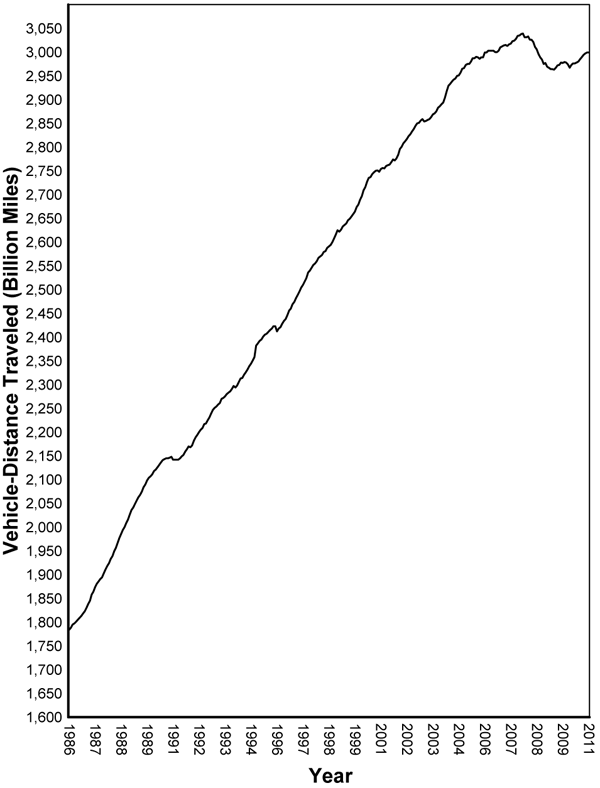
Second, if oil and oil products like gasoline are so much more expensive for us that we change our consumption how can the Chinese and Indians consume more. I think the answer lies in how far one's energy goes. Another post on The OilDrum by Gail Tverberg suspect's that because the American infrastructure requires a higher EROEI (Energy Returned on Energy Invested) than Chinese or Indian infrastructure, the impact of higher prices of energy is much greater in America than in Chindia...or maybe it's just because the Chinese have our money in trade surplus that allows them to subsidize oil consumption?
So, I hope you can see that any change in gasoline prices due to military action by the US is not going to address the root causes of high prices. I think Donald Trump has lived too long in the world of high finance, where lot's of capital resources and shrewd bargaining can solve any monetary problem. If only oil were like money and we could print more of it!
Thursday, April 15, 2010
Social responsibility and privacy erosion
My colleagues and I had a discussion on why academic medical centers would never adopt Gmail this morning. I then missed an appointment and had a chance to catch up on Bruce Schneier's Crypto-Gram from April 15, 2010. I would like to quote Bruce Schneier:
"With all this privacy erosion, those CEOs may actually be right -- but only because they're working to kill privacy. On the Internet, our privacy options are limited to the options those companies give us and how easy they are to find. We have Gmail and Facebook accounts because that's where we socialize these days, and it's hard -- especially for the younger generation -- to opt out. As long as privacy isn't salient, and as long as these companies are allowed to forcibly change social norms by limiting options, people will increasingly get used to less and less privacy. There's no malice on anyone's part here; it's just market forces in action. If we believe privacy is a social good, something necessary for democracy, liberty and human dignity, then we can't rely on market forces to maintain it. Broad legislation protecting personal privacy by giving people control over their personal data is the only solution."
Bruce concluded that only legislation will work. I think that's only partially true. People can waive their rights and give away or sell their privacy and that will always be legal. Social Responsibility exists in the corporate world and exists alongside market forces. I think about this from the perspective of the 'corporate' world and the 'consumer' world. In the corporate world we have lot's of privacy (at least between the corporation and outside, not necessarily with each other) and most corporations and public entities are strongly in the camp of "We can't loose control of our data, thus we can't use GMail", etc. What this does, is leave the GMails and Facebooks of the world with no powerful rudder to counteract their tendencies to make money through erosion of privacy. By large public institutions and powerful private organizations 'opting' out of the 'social internet' of GMail and Facebook, we leave the consumers to deal with those entities on a one by one basis. That's why Bruce thinks we need legislation - individuals are relatively powerless and he believes that public/private organizations will not act on their own with profits at stake. I think that large public and private entities must directly engage with the consumer social networks by using them and demand privacy and pay real dollars for it to be delivered, thus providing a counter incentive for profit from erosion. That would be social responsibility and 'good will' for these organizations. It might even lower their IT costs. And our tax supported public institutions should not even need an incentive to do this, they should be acting in our interests.
I think that large organizations not engaging with the social internet by using it internally is counter-productive and will make the public/private security cocoon more porous. Privacy erosion will get worse and public and private institutions more prone to data loss from inside. Since consumer internet technology is in daily use by employee's (by definition, the consumer) and we already know how powerless corporate IT has been in stopping these technologies from getting used at work, A growing gulf between privacy expectations and behavior is developing between the organization and it's people. Corporate technology can and will continue to 'divorce itself' from the social internet technologies, by delivering the firewalled, vpn'd, streamed and virtualized application container on top of consumer technology. This direction will consume lot's of corporate IT energy and dollars. It will not stop the erosion of privacy and it will not stop the release of 'confidential' data. Enforcement of data privacy regulation, in the face of massive corporate profits to be made from loss of privacy will be an order of magnitude harder than enforcing the drug laws. I think we all know where drug enforcement has led us. Right now, the University of Michigan has banned all sponsored travel to Northern Mexico because of drug violence.....what a great outcome....Image similar outcomes with data privacy....
Subscribe to:
Posts (Atom)