I re-read my post from yesterday (that means at least one person has read my entries :) and realize that it could give the wrong impression. What I meant to say is that the content of the blogosphere reactions is political not scientific, although it claims to be about science...
The level of cross-linking and commentary triggered by Mark Lynas's single post creates a hyper-storm of content. This massive increase in information contains absolutely no increase in knowledge. From this kind of behavior, it's easy to see that after enough of these hyper-storms, finding knowledge in the sea of information get's harder. Already google searches return so much information that one has to be selective in what one chooses to follow-up on, and if you are trying to discern what is actually happening, then good luck.
Let me give a good example. Yesterday I found a youtube video of what looks to be steam release from fukushima reactor 4 that took place on June 14th. Some people called it an explosion, but I can't tell from that video what is happening. Searching the web for an explanation is nearly hopeless, the majority of links are dire warnings for which this 'explosion' is yet more proof for the point of view of the author with a link back to the youtube video.
It's easy to say that no one bothers to check facts anymore, but when it's this difficult, it's hard to see any other outcome but increased paranoia among the people who routinely plug into this stream of self-referential links. It's also easy to see how one can get the impression that the evidence for whatever you are talking about, in this case the 'explosion', is overwhelming, why I found 25 links talking about it!
Friday, June 17, 2011


Wednesday, June 15, 2011
IPCC shoot's itself in foot again.
Will the IPCC loose credibility with this event described by Mark Lynas: http://www.marklynas.org/2011/06/new-ipcc-error-renewables-report-conclusion-was-dictated-by-greenpeace/ ?
I suspect so, at least among non-scientists.
You can feel the frustration in Mark Lynas's response. You see, science needs to be 100% perfect in it's communications and on the Internet. It can't make mistakes or have people associated with it that have other, non-scientific, purposes.
The majority of critics get to play by different rules than science. James Hansen has noted that policy discussions and most public discussions take place using rules of Law. Climate Change is treated as the prosecutions case and all that is needed is to create reasonable doubt in at least one of twelve juror's. In other words, critics behave as lawyers and look for flaws.
Scientists look for flaws too and often discuss all possibilities. That is why the legal approach to science criticism is so effective, your 'opponent' provides more than enough 'evidence' to create doubt and spread the impression of confusion and malfeasance in the scientists.
Mark is right about the IPCC 'blowing' this. From a scientific perspective throwing out the possibility that renewable energy can reach 80% is ok, especially if it sparks examination about that goal. But that is not what is happening, because this was not science, it was a press release. Different rules are at play here. Climate Change, for the public, is a propaganda war now, not a scientific exercise.
I suspect so, at least among non-scientists.
You can feel the frustration in Mark Lynas's response. You see, science needs to be 100% perfect in it's communications and on the Internet. It can't make mistakes or have people associated with it that have other, non-scientific, purposes.
The majority of critics get to play by different rules than science. James Hansen has noted that policy discussions and most public discussions take place using rules of Law. Climate Change is treated as the prosecutions case and all that is needed is to create reasonable doubt in at least one of twelve juror's. In other words, critics behave as lawyers and look for flaws.
Scientists look for flaws too and often discuss all possibilities. That is why the legal approach to science criticism is so effective, your 'opponent' provides more than enough 'evidence' to create doubt and spread the impression of confusion and malfeasance in the scientists.
Mark is right about the IPCC 'blowing' this. From a scientific perspective throwing out the possibility that renewable energy can reach 80% is ok, especially if it sparks examination about that goal. But that is not what is happening, because this was not science, it was a press release. Different rules are at play here. Climate Change, for the public, is a propaganda war now, not a scientific exercise.
Tuesday, April 19, 2011
Wow - Donald Trump
So, I have not posted in months, but I saw George Stephanopoulos's interview this morning. Apparently Mr. Trump thinks that we can threaten the worlds suppliers of oil to lower their price and/or increase their production ( to lower the price) by withdrawing US military protection. I think that whether or not we can afford to provide a military presence around the world, let alone in the Persian Gulf, is a good thing to discuss. But the consequences for world oil supply are not going to be that simple.
Sure, I think that if the US chooses to act as a financial trader and ruthlessly manipulate the oil markets even to the extent of invoking our military, prices could go down, but only for a while......they could also go up, way up! But just a spike way up. That's because I think there is some evidence that the world economy and oil prices are in a balancing act. We have reached the point where serious price escalation reduces demand, high prices create a recession and that keeps demand tamped down which creates oil surplus which lowers the price and given other macro economic conditions we can start pulling out of the recession, increase demand and start the whole thing over again....
You can read about this at Robert Rapier's consumer energy blog and also find pointers to other economic analysis. Robert call's this phenomena the "long recession'.
And yet another problem we face is that any surplus that is created by OECD demand destruction is consumed by the rest of world, leaving little surplus for us to build future growth on. Here is a sobering analysis by Jeffrey J. Brown over at the The Oil Drum (handle: westexas): In 2005, the top 33 oil exporting countries in the world produced 62.2 mbpd (million barrels per day) and exported 46 mbpd, that means they consumed, internally in their country about 26% of production. China and India imported 11% of what was exported. In 2009, those same countries produced 60.3 mbpd, consumed 17.5 mppd (about 27.5%), exported 42.8 mbpd and China and India imported 17% of that!
Note two things there, the producing countries are slowly consuming more of their production and the great growth rates in China and India are consuming a ever higher fraction of world oil exports.
So how can this be? How can 2 countries which are considerably poorer per capita than the US be able to afford the oil that we can't afford!
First, is it really true that we in the US are consuming less crude oil? In 2009, US oil consumption was lower than it was in 1998. The downtown in growth started in 2005 for the US and really picked up steam in 2008. From the dot.gov site we can look at monthly and annual miles driven in the US (a proxy for overall oil consumption):
 The peak was actually in February of 2008 and we have not recovered back to that level yet. Probably won't this year either. The point is that American's responded to higher oil prices by driving less thus consuming less.
Second, if oil and oil products like gasoline are so much more expensive for us that we change our consumption how can the Chinese and Indians consume more. I think the answer lies in how far one's energy goes. Another post on The OilDrum by Gail Tverberg suspect's that because the American infrastructure requires a higher EROEI (Energy Returned on Energy Invested) than Chinese or Indian infrastructure, the impact of higher prices of energy is much greater in America than in Chindia...or maybe it's just because the Chinese have our money in trade surplus that allows them to subsidize oil consumption?
So, I hope you can see that any change in gasoline prices due to military action by the US is not going to address the root causes of high prices. I think Donald Trump has lived too long in the world of high finance, where lot's of capital resources and shrewd bargaining can solve any monetary problem. If only oil were like money and we could print more of it!
Sure, I think that if the US chooses to act as a financial trader and ruthlessly manipulate the oil markets even to the extent of invoking our military, prices could go down, but only for a while......they could also go up, way up! But just a spike way up. That's because I think there is some evidence that the world economy and oil prices are in a balancing act. We have reached the point where serious price escalation reduces demand, high prices create a recession and that keeps demand tamped down which creates oil surplus which lowers the price and given other macro economic conditions we can start pulling out of the recession, increase demand and start the whole thing over again....
You can read about this at Robert Rapier's consumer energy blog and also find pointers to other economic analysis. Robert call's this phenomena the "long recession'.
And yet another problem we face is that any surplus that is created by OECD demand destruction is consumed by the rest of world, leaving little surplus for us to build future growth on. Here is a sobering analysis by Jeffrey J. Brown over at the The Oil Drum (handle: westexas): In 2005, the top 33 oil exporting countries in the world produced 62.2 mbpd (million barrels per day) and exported 46 mbpd, that means they consumed, internally in their country about 26% of production. China and India imported 11% of what was exported. In 2009, those same countries produced 60.3 mbpd, consumed 17.5 mppd (about 27.5%), exported 42.8 mbpd and China and India imported 17% of that!
Note two things there, the producing countries are slowly consuming more of their production and the great growth rates in China and India are consuming a ever higher fraction of world oil exports.
So how can this be? How can 2 countries which are considerably poorer per capita than the US be able to afford the oil that we can't afford!
First, is it really true that we in the US are consuming less crude oil? In 2009, US oil consumption was lower than it was in 1998. The downtown in growth started in 2005 for the US and really picked up steam in 2008. From the dot.gov site we can look at monthly and annual miles driven in the US (a proxy for overall oil consumption):
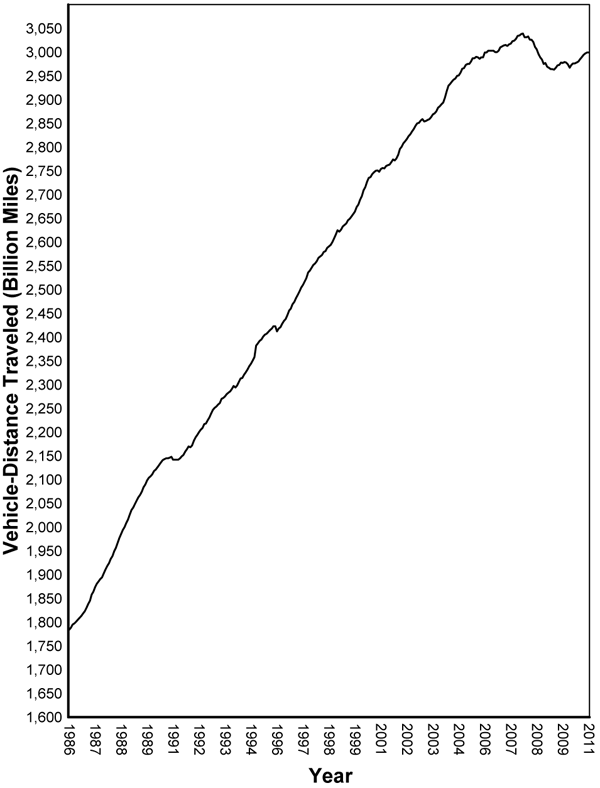
Second, if oil and oil products like gasoline are so much more expensive for us that we change our consumption how can the Chinese and Indians consume more. I think the answer lies in how far one's energy goes. Another post on The OilDrum by Gail Tverberg suspect's that because the American infrastructure requires a higher EROEI (Energy Returned on Energy Invested) than Chinese or Indian infrastructure, the impact of higher prices of energy is much greater in America than in Chindia...or maybe it's just because the Chinese have our money in trade surplus that allows them to subsidize oil consumption?
So, I hope you can see that any change in gasoline prices due to military action by the US is not going to address the root causes of high prices. I think Donald Trump has lived too long in the world of high finance, where lot's of capital resources and shrewd bargaining can solve any monetary problem. If only oil were like money and we could print more of it!
Thursday, April 15, 2010
Social responsibility and privacy erosion
My colleagues and I had a discussion on why academic medical centers would never adopt Gmail this morning. I then missed an appointment and had a chance to catch up on Bruce Schneier's Crypto-Gram from April 15, 2010. I would like to quote Bruce Schneier:
"With all this privacy erosion, those CEOs may actually be right -- but only because they're working to kill privacy. On the Internet, our privacy options are limited to the options those companies give us and how easy they are to find. We have Gmail and Facebook accounts because that's where we socialize these days, and it's hard -- especially for the younger generation -- to opt out. As long as privacy isn't salient, and as long as these companies are allowed to forcibly change social norms by limiting options, people will increasingly get used to less and less privacy. There's no malice on anyone's part here; it's just market forces in action. If we believe privacy is a social good, something necessary for democracy, liberty and human dignity, then we can't rely on market forces to maintain it. Broad legislation protecting personal privacy by giving people control over their personal data is the only solution."
Bruce concluded that only legislation will work. I think that's only partially true. People can waive their rights and give away or sell their privacy and that will always be legal. Social Responsibility exists in the corporate world and exists alongside market forces. I think about this from the perspective of the 'corporate' world and the 'consumer' world. In the corporate world we have lot's of privacy (at least between the corporation and outside, not necessarily with each other) and most corporations and public entities are strongly in the camp of "We can't loose control of our data, thus we can't use GMail", etc. What this does, is leave the GMails and Facebooks of the world with no powerful rudder to counteract their tendencies to make money through erosion of privacy. By large public institutions and powerful private organizations 'opting' out of the 'social internet' of GMail and Facebook, we leave the consumers to deal with those entities on a one by one basis. That's why Bruce thinks we need legislation - individuals are relatively powerless and he believes that public/private organizations will not act on their own with profits at stake. I think that large public and private entities must directly engage with the consumer social networks by using them and demand privacy and pay real dollars for it to be delivered, thus providing a counter incentive for profit from erosion. That would be social responsibility and 'good will' for these organizations. It might even lower their IT costs. And our tax supported public institutions should not even need an incentive to do this, they should be acting in our interests.
"With all this privacy erosion, those CEOs may actually be right -- but only because they're working to kill privacy. On the Internet, our privacy options are limited to the options those companies give us and how easy they are to find. We have Gmail and Facebook accounts because that's where we socialize these days, and it's hard -- especially for the younger generation -- to opt out. As long as privacy isn't salient, and as long as these companies are allowed to forcibly change social norms by limiting options, people will increasingly get used to less and less privacy. There's no malice on anyone's part here; it's just market forces in action. If we believe privacy is a social good, something necessary for democracy, liberty and human dignity, then we can't rely on market forces to maintain it. Broad legislation protecting personal privacy by giving people control over their personal data is the only solution."
Bruce concluded that only legislation will work. I think that's only partially true. People can waive their rights and give away or sell their privacy and that will always be legal. Social Responsibility exists in the corporate world and exists alongside market forces. I think about this from the perspective of the 'corporate' world and the 'consumer' world. In the corporate world we have lot's of privacy (at least between the corporation and outside, not necessarily with each other) and most corporations and public entities are strongly in the camp of "We can't loose control of our data, thus we can't use GMail", etc. What this does, is leave the GMails and Facebooks of the world with no powerful rudder to counteract their tendencies to make money through erosion of privacy. By large public institutions and powerful private organizations 'opting' out of the 'social internet' of GMail and Facebook, we leave the consumers to deal with those entities on a one by one basis. That's why Bruce thinks we need legislation - individuals are relatively powerless and he believes that public/private organizations will not act on their own with profits at stake. I think that large public and private entities must directly engage with the consumer social networks by using them and demand privacy and pay real dollars for it to be delivered, thus providing a counter incentive for profit from erosion. That would be social responsibility and 'good will' for these organizations. It might even lower their IT costs. And our tax supported public institutions should not even need an incentive to do this, they should be acting in our interests.
I think that large organizations not engaging with the social internet by using it internally is counter-productive and will make the public/private security cocoon more porous. Privacy erosion will get worse and public and private institutions more prone to data loss from inside. Since consumer internet technology is in daily use by employee's (by definition, the consumer) and we already know how powerless corporate IT has been in stopping these technologies from getting used at work, A growing gulf between privacy expectations and behavior is developing between the organization and it's people. Corporate technology can and will continue to 'divorce itself' from the social internet technologies, by delivering the firewalled, vpn'd, streamed and virtualized application container on top of consumer technology. This direction will consume lot's of corporate IT energy and dollars. It will not stop the erosion of privacy and it will not stop the release of 'confidential' data. Enforcement of data privacy regulation, in the face of massive corporate profits to be made from loss of privacy will be an order of magnitude harder than enforcing the drug laws. I think we all know where drug enforcement has led us. Right now, the University of Michigan has banned all sponsored travel to Northern Mexico because of drug violence.....what a great outcome....Image similar outcomes with data privacy....
Saturday, February 27, 2010
I am speechless
I can't even muster up a response to this from the house side of S. Dakota:
NOW, THEREFORE, BE IT RESOLVED, by the House of Representatives of the Eighty-fifth Legislature of the State of South Dakota, the Senate concurring therein, that the South Dakota Legislature urges that instruction in the public schools relating to global warming include the following:
(1) That global warming is a scientific theory rather than a proven fact;
(2) That there are a variety of climatological, meteorological, astrological, thermological, cosmological, and ecological dynamics that can effect [sic] world weather phenomena and that the significance and interrelativity of these factors is largely speculative; and
(3) That the debate on global warming has subsumed political and philosophical viewpoints which have complicated and prejudiced the scientific investigation of global warming phenomena; and
BE IT FURTHER RESOLVED, that the Legislature urges that all instruction on the theory of global warming be appropriate to the age and academic development of the student and to the prevailing classroom circumstances.
Monday, February 8, 2010
High CO2 reduces roundup effectiveness http://goo.gl/652N
I encourage everyone to download and read the climate change report put out by the US Global Change Research Consortium.
http://goo.gl/652N
Here is an excerpt:
"Controlling weeds currently costs the United States
more than $11 billion a year, with the majority
spent on herbicides;241 so both herbicide use and
costs are likely to increase as temperatures and
carbon dioxide levels rise. At the same time, the
most widely used herbicide in the United States,
glyphosate (RoundUp®), loses its efficacy on weeds
grown at carbon dioxide levels that are projected
to occur in the coming decades (see photos below).
Higher concentrations of the chemical and more
frequent spraying thus will be needed, increasing
economic and environmental costs associated with
chemical use."
Monday, February 1, 2010
Too little time is the reality
Or not enough time....So how do things end up taking so much time.......
First, understand that what I am talking about is a complex system with 100's of components and 1000's of technical details, i.e. a medium size IT operation.....
The system is complex because there are dependencies among the components. The Network infrastructure is really a lot appliance computers dedicated to networking, with often remote services from outsource providers. Storage is often handled centrally by a SAN or a NAS and there are usually multiples of them at various stages of life cycle. Then there are other shared resources, authentication servers, time servers, database servers......some can be outsourced as well.
Each of these groups have multiple parts or future possibilities: speed, size, expandability, power consumption, space consumption, robustness, life cycle (depreciation) and technical compatibility with other components.
Here is an example of what I mean.
We want to expand one type of storage. This storage needs to be in a specific location because of networking constraints. That location has space but no power available. There is a set of servers in the space that are being retired and eventually replaced by servers in another location. That's where the power will come from, retiring these servers. To do that we need to schedule downtime with the users. Their next window is three weeks out. In the mean time, we realize that this server we are moving can't move because it's dependency on a local SAN storage is not moving with it. That's not moving because another server is using it that can't move in the same time frame. We now have to schedule a replace storage expansion at another location. That's going to put us beyond the first three week window, and the next window is a month away. So can we get this storage expansion (not the same storage as we started with) done before the next downtime window? And guess what? We are back to the beginning of this process, but with a whole different objective. And on it goes.....
Subscribe to:
Posts (Atom)